
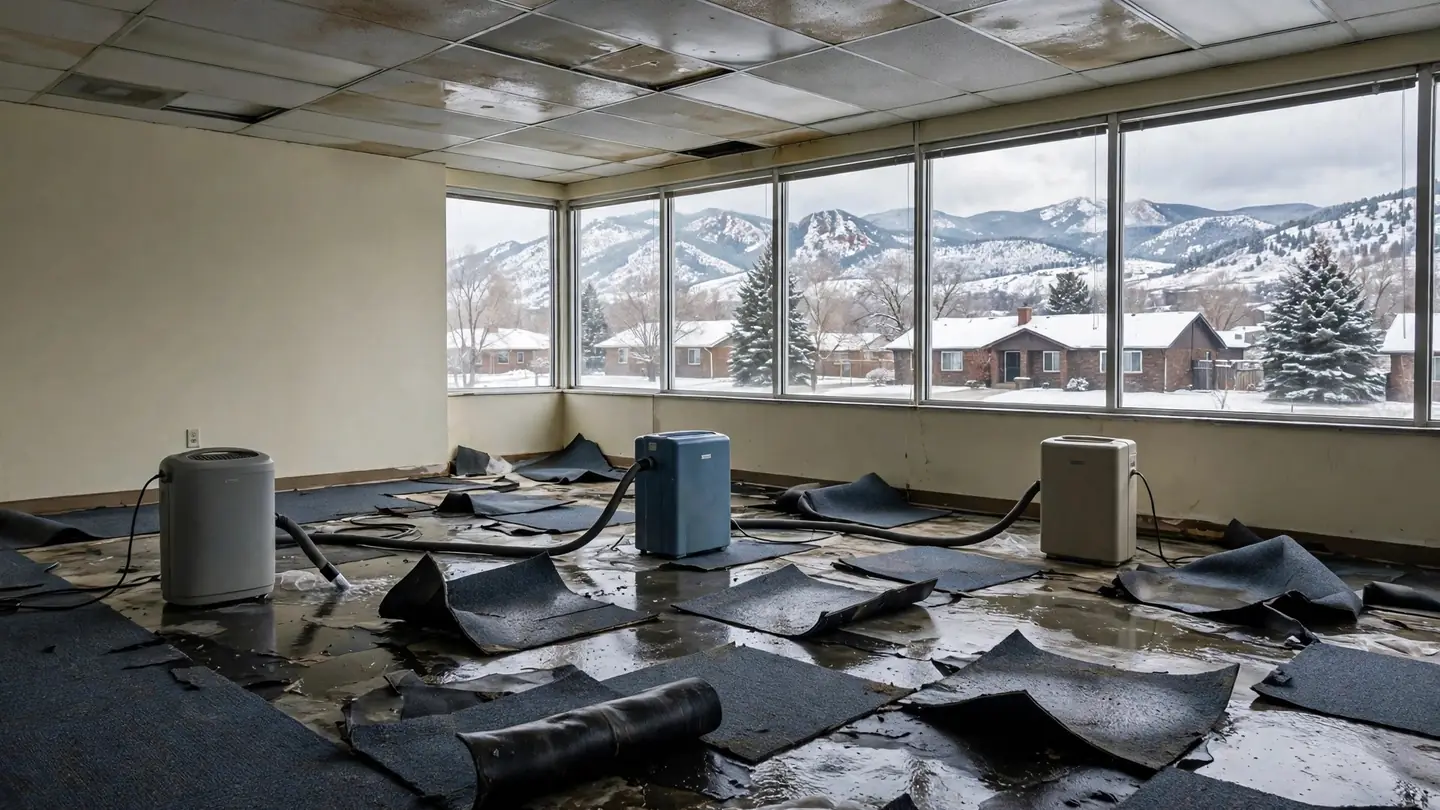
Key facts: Commercial Water Damage
- Commercial water losses often involve larger areas, more people and more stakeholders than residential ones, including owners, tenants, property managers and insurers.
- Fire sprinkler discharges release large volumes of water quickly and often involve water that has been sitting in pipes for years.
- Commercial carpet tiles, raised floors and suspended ceilings each need different handling during drying.
- Food businesses that flood may need to follow public health guidance before reopening.
- Wheat Ridge's commercial corridors include Wadsworth Boulevard, Kipling Street, 38th Avenue and the area around I-70.
Scope
What commercial water damage restoration covers
The steps are the same as in a home. What changes is scale, the number of people involved and the pressure to reopen.
- Emergency responseStopping the water, making the space safe and protecting stock, equipment and records.
- Extraction and removalRemoving water from large floor areas and taking out materials that cannot be dried.
- Structural dryingLarge-scale dehumidification, often with temporary power and climate control.
- Contents and equipmentMoving, cleaning, drying or packing out furniture, inventory and documents.
- CoordinationWorking with owners, tenants, property managers, adjusters and other trades.
Local businesses
Commercial property in Wheat Ridge
Wheat Ridge's commercial buildings range widely. Along Wadsworth Boulevard and Kipling Street there are strip centers, pad sites and older single-storey retail buildings. The 38th Avenue corridor, branded Ridge at 38, mixes small shops, restaurants and offices in older buildings with newer mixed-use projects. Around I-70 and the Clear Creek area there are larger retail, office and light industrial sites, and multifamily buildings are scattered through the city.
Each type brings different water risks. Older single-storey buildings often have flat roofs with internal drains that can clog. Restaurants have floor drains, grease traps and kitchen equipment with water lines. Multifamily buildings have stacked bathrooms where one unit's overflow becomes another's ceiling leak. Light industrial buildings may have fire sprinkler systems and slab floors with stock stored directly on them.
Causes
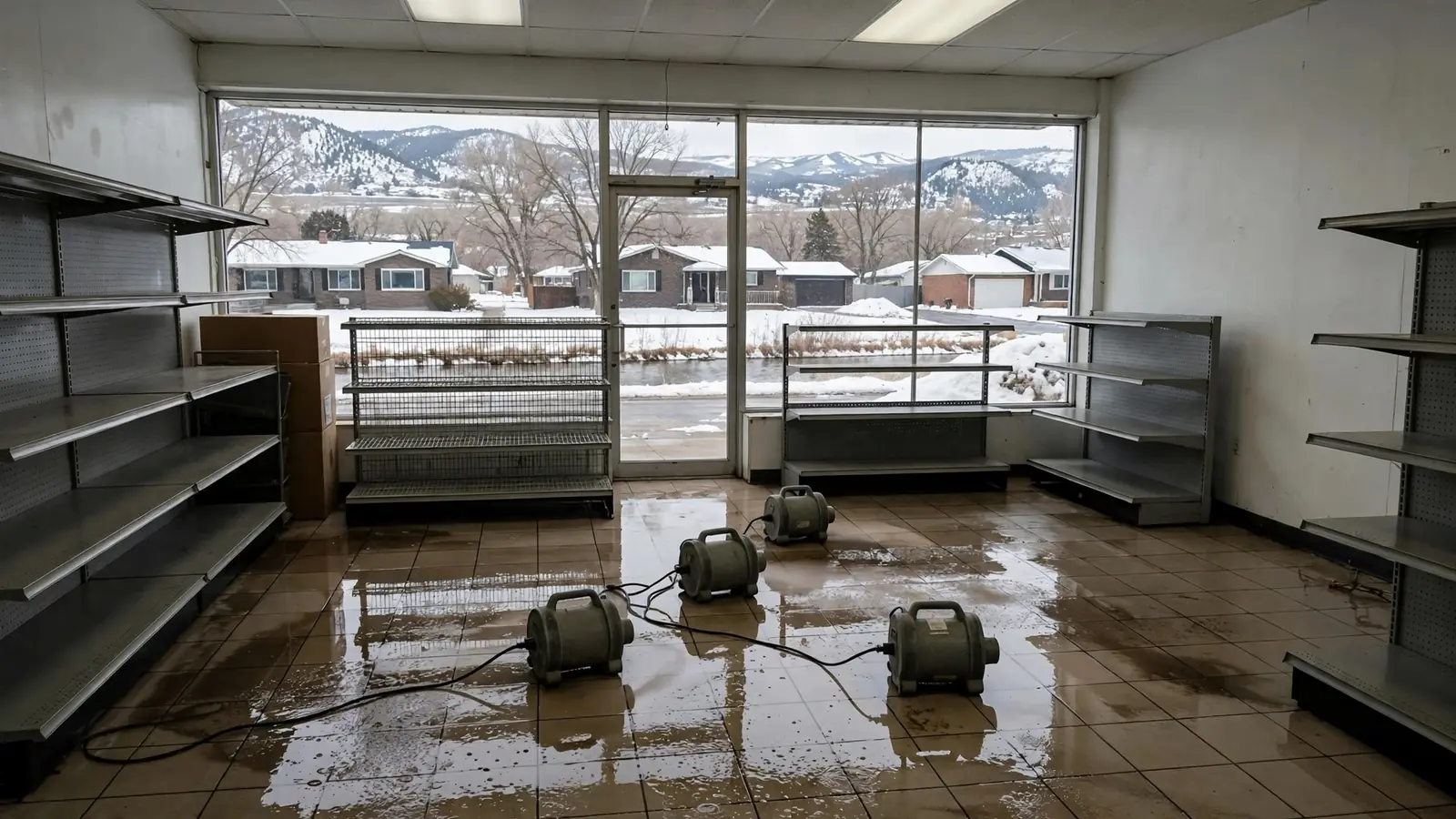
Common causes of commercial water losses
Fire sprinkler discharge
Heads damaged by forklifts or ladders, or frozen pipes in unheated areas, release water fast.
Roof and roof drain leaks
Flat roofs pond water; clogged internal drains back up into suites below.
Supply line failures
Ice makers, coffee machines, restroom fixtures and water heaters fail, often after hours.
Sewer backups
Restaurants and older buildings can back up through floor drains.
HVAC condensate
Rooftop units and air handlers can overflow drain pans into ceilings.
Storm runoff
Water entering at storefront doors or loading docks during heavy rain.
Sprinklers
Fire sprinkler leaks and discharges
A sprinkler discharge is one of the most sudden commercial losses. A single head can release a large volume of water per minute until the system is shut off, and because sprinkler water sits in steel pipes for years, it is often dark, oily and smelly. It soaks ceilings, insulation, carpet and stock below.
The first step is shutting off the system, which should be done by someone who knows where the control valve is and is authorized to close it, and then notifying the fire department and the sprinkler contractor, since the building may need a fire watch until protection is restored. Restoration can start once the water is stopped. Many commercial insurance policies cover sudden sprinkler discharges, but owners should check.
Commercial process
How a commercial water job is managed
- 1
Initial site visit
Assess the extent of water, safety hazards, affected tenants and what must be protected first.
- 2
Agree access and scope
Work out with the owner or manager which areas can be closed, what hours crews can work and who approves changes.
- 3
Protect critical items
Move records, computers, inventory and equipment out of harm's way.
- 4
Extract and remove
Remove water and take out wet carpet tiles, ceiling tiles, drywall and insulation as needed.
- 5
Dry
Set up large dehumidifiers and air movers; use temporary power if the building's circuits cannot support the equipment.
- 6
Document
Keep photo records, moisture maps and daily logs for owners, tenants and insurers.
- 7
Hand over
Confirm dryness, remove equipment and hand the space back for rebuild.
Building features
How commercial building features affect drying
| Feature | Issue after water | Typical handling |
|---|---|---|
| Suspended ceiling tiles | Stain and sag; hold water above the grid | Replace wet tiles; check above the grid |
| Carpet tiles | Water runs under and between tiles | Lift, dry slab, reuse tiles if clean water and dried quickly |
| Glue-down carpet | Holds water against the slab | Often removed to dry the floor |
| Metal stud walls | Studs dry well; drywall and insulation do not | Remove wet board and insulation |
| Raised access floors | Water collects under the floor | Lift panels and dry the void |
| Concrete slabs | Hold water for a long time | Long drying, test before new flooring |
Staying open
Keeping a business running during restoration
Most businesses cannot simply close for a week. A good commercial restoration plan finds ways to keep part of the space working: drying one section at a time, working nights and weekends, putting up containment walls so customers do not walk through the work area, and routing equipment exhaust and noise away from occupied rooms.
This takes planning on the first visit. Tell the contractor your opening hours, peak days, which areas you must keep open and what you can do without. Some compromises are unavoidable, for example drying equipment that has to run during business hours, but much can be arranged.
Restaurants
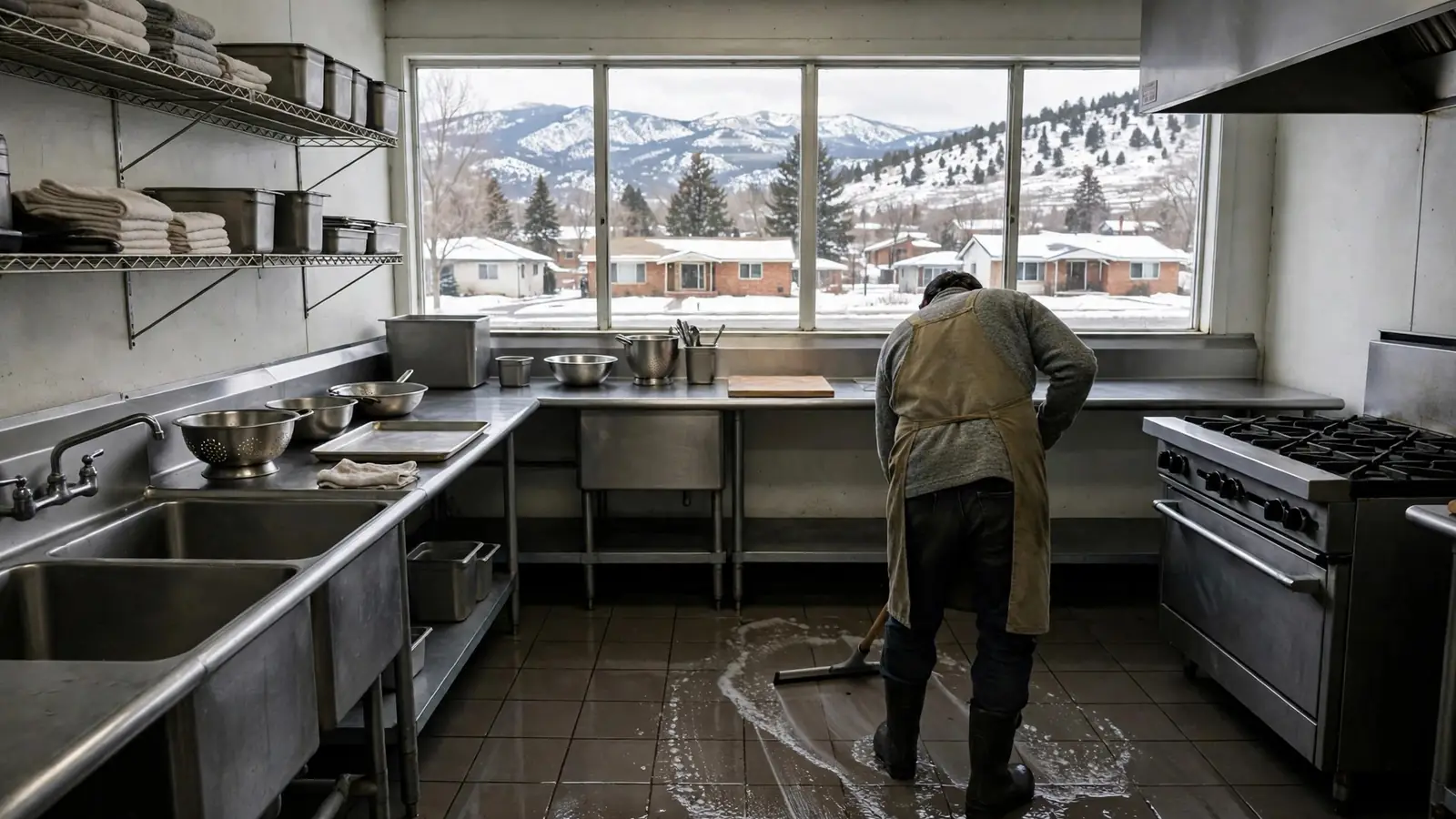
Water damage in restaurants and food businesses
Restaurants face strict rules after water damage. If water from a sewer backup, flood or ceiling leak reaches food preparation or storage areas, food that may have been contaminated has to be discarded and surfaces cleaned and sanitized before service resumes. Jefferson County Public Health oversees food establishments in Wheat Ridge and is the place to check reopening requirements.
Kitchen equipment that stood in water, walk-in coolers with wet insulation and floors with grout lines that absorbed contaminated water all need attention. Grease traps and floor drains should be checked as a possible cause before the kitchen is put back into service.
- Discard food touched by contaminated water
- Contact public health about reopening
- Check floor drains and grease traps
Multifamily
Apartment and condo buildings
In apartment and condo buildings, water rarely stays in one unit. An overflowing tub or failed washing machine on an upper floor can soak the units below, the hallway and sometimes the units beside it. That makes the first hour about finding every affected space, which means knocking on doors and getting access to units whose occupants may be away.
Responsibility is often split. In a condominium, the association may be responsible for common elements and the structure, while owners handle interiors and contents, depending on the declaration. Renters need their own renters insurance for their belongings. A contractor working in a multifamily building should keep each unit's damage, photos and readings separate, because different insurers may be paying for different parts.
Offices
Offices, clinics and records
For offices and medical or dental clinics, the biggest worries are usually records, computers and specialized equipment. Paper files that get wet can be frozen to stop mold and ink damage, then dried by document restoration specialists. Electronics should be unplugged and kept out of humid air; do not power up equipment that got wet until it is checked.
Clinics have extra considerations, including sterile storage areas and equipment that may need manufacturer checks. Offices with carpet tile can often be dried faster than those with glue-down broadloom. Ceiling leaks over workstations call for checking above every nearby ceiling tile, since water spreads across the top of the grid.
Who does what
Who is responsible for what in a commercial loss
| Party | Usually responsible for |
|---|---|
| Building owner | Structure, roof, building systems, common areas, the building policy |
| Tenant | Their improvements, furniture, stock and equipment, business interruption cover |
| Property manager | Coordinating access, contractors and communication |
| Insurers | Paying covered losses under each policy |
| Restoration contractor | Mitigation, drying and documentation for whoever hires them |
Documentation
Records insurers and owners will want
Commercial claims are often larger and more scrutinized than residential ones. Insurers will expect a clear record of the cause, the affected area, the materials removed, the equipment used and the readings showing the space was dried. Business interruption claims may also need evidence of when the space was unusable and when it was handed back.
Ask the contractor for daily logs and photos, and keep your own record of closed hours, cancelled appointments and moved operations. If several tenants are affected, make sure each one's documentation is separate.
Mold
Mold risk in commercial buildings
Commercial buildings have more hidden places for moisture: above suspended ceilings, inside insulated metal stud walls, under glue-down flooring and behind built-in casework. Mold can grow in these spaces without anyone seeing it. The EPA notes that controlling moisture is the key to controlling mold in large buildings as well as homes.
Thorough drying, with readings taken inside walls and above ceilings, is the best defense. If mold is found, the area may need containment and removal by trained workers, and occupants may need to be kept out of the affected area.
Prevention
Reducing water risk at a commercial property
Many commercial losses start with something maintenance could have caught: clogged roof drains, aging supply lines, condensate pans that overflow, or sprinkler pipes in unheated areas that freeze. Seasonal roof inspections, especially before spring storms and after heavy snow, prevent a lot of damage. Water leak sensors in server rooms, under restroom fixtures and near water heaters give early warning after hours.
Know where the main water shutoff and sprinkler control valve are and make sure more than one person can reach them. Keep stock and records off the floor where possible, and keep an emergency contact list for owners, tenants and trades posted where staff can find it.
On the call
Questions for a commercial restoration contractor
- Can you work after hours?Ask about nights and weekends if you need to stay open.
- How will you keep customers and staff safe?Expect containment, signage and clear walkways.
- Do you need temporary power?Large drying jobs can exceed the building's available circuits.
- How will you document each tenant's area?Separate records matter when several parties are involved.
- Who should we contact about the sprinkler system?They should direct you to the sprinkler contractor and fire department.
Flat roofs
Flat roofs, roof drains and snow loads
Many single-storey commercial buildings in Wheat Ridge have low-slope roofs drained by internal roof drains or scuppers. When leaves, gravel or ice block a drain, water ponds on the roof and finds the weakest seam, often directly over a tenant's suite. Heavy Front Range spring snow adds weight and, as it melts, a lot of water in a short time.
Roof leaks inside a commercial building often show up far from where they start, because water runs along the deck, insulation and structure before dripping through. Ceiling tiles in a wide area around a visible leak should be checked. Restoration covers the interior damage; the roof itself needs a roofer, and a temporary repair or tarp may be needed before drying can succeed.
Warehouses
Warehouses and light industrial buildings
In warehouses, the main concern is usually stock stored on the floor or low racking. Cardboard packaging wicks water quickly and can collapse, damaging goods and creating hazards in the racking. Pallets can be moved with forklifts, but only once the floor is safe and electrical hazards are controlled.
Concrete slabs in warehouses are large and thick, and they dry slowly. Dehumidification in a high-ceilinged space is more effective if the wet area can be enclosed with plastic or the building's doors kept closed. Where the business handles chemicals, the contractor needs to know so that contaminated water can be handled properly.
First hour
First steps for a business owner or manager
- 1
Stop the water
Close the nearest valve or the main shutoff; for sprinklers, follow fire safety procedures.
- 2
Make it safe
Keep staff and customers out of wet areas with electrical equipment; cut power to affected circuits if it can be done safely.
- 3
Protect what matters most
Move records, computers and high-value stock up and away from water.
- 4
Notify people
Tell the building owner or manager, adjoining tenants and your insurer.
- 5
Record it
Take photos and video of the source, the extent and damaged items before anything is moved.
Schools and churches
Churches, schools and community buildings
Community buildings often have large open rooms, basements used for meetings or classrooms, older plumbing and volunteers rather than facility staff. A leak may go unnoticed over a weekend or a holiday. When it is found, the questions are similar to any commercial job: who has authority to approve work, which spaces must be ready by a fixed date, and what records must be kept for the insurer or governing body.
Older community buildings may contain materials that need testing before demolition, such as old floor tile or pipe insulation. Ask about this before any removal starts.
Rebuild
Planning the rebuild after a commercial loss
Once the space is dry, the rebuild often involves different trades: drywall, flooring, ceiling grid, electrical, plumbing and finishes. Tenant improvements may need to match the original specification or the lease. Some restoration firms carry out the rebuild themselves; others hand off to a general contractor. Commercial rebuild work in Wheat Ridge may need permits and inspections through the city's Building Division.
Allow time for lead times on commercial materials such as specific carpet tiles or ceiling tiles. It sometimes helps to order replacements while drying is still under way.
Medical and labs
Dental offices, clinics and specialized spaces
Some Wheat Ridge commercial tenants run equipment that does not tolerate water or humidity: dental chairs and compressors, imaging equipment, laboratory instruments, salon equipment with electrical components, and server closets. These items should be powered down and checked by the manufacturer or a qualified technician before use.
Clinics also need to think about infection control. If contaminated water reached treatment rooms, cleaning and disinfection must meet the standard the practice follows, and the contractor should coordinate with the practice manager on how rooms are released back into use.
Downtime
What usually drives downtime in a commercial loss
| Factor | Effect on downtime |
|---|---|
| How fast water was stopped | Every hour of flow widens the damaged area |
| Water category | Contaminated water means more removal and cleaning |
| Flooring type | Carpet tile and sealed concrete dry faster than glue-down flooring |
| Access hours | After-hours work keeps a business trading but stretches the schedule |
| Rebuild materials | Special-order finishes add time after drying |
Vacant space
Vacant suites and buildings
Water losses in vacant suites often go unnoticed the longest. A frozen pipe in an unheated empty unit, or a roof leak over a space nobody visits, can run for days. When it is found, mold may already be present and the damage may have spread into occupied neighbours. Owners of vacant space should keep heat on through the winter, shut off water to unused fixtures, and have someone walk the space regularly.
Property types
Wheat Ridge property types callers ask about
Strip-center retail
Shared roofs and walls mean one suite's leak can reach the next.
Restaurants and cafes
Kitchens, floor drains and food safety rules.
Medical and dental offices
Records, equipment and infection control.
Apartment buildings
Stacked units and many occupants to notify.
Warehouses and shops
Stock on slabs, high ceilings and sprinkler systems.
Churches and halls
Large rooms, basements and volunteer management.
Communication
Keeping everyone informed
Commercial losses involve more people than a house: owners, tenants, staff, customers, managers and often more than one insurer. A short daily update by email or text, with what was done, what readings show and what happens next, prevents a lot of confusion. Agree at the start who receives updates and who can approve extra work, so decisions are not held up.
FAQ
Commercial water damage questions in Wheat Ridge
Can we stay open during restoration?
Often in part. Drying can be phased and contained so some areas stay in use.
Who pays when water from one tenant damages another?
It depends on the leases and policies involved. Each party should notify their insurer.
How quickly can a crew start?
Emergency calls are taken around the clock. You will be connected with an independent contractor who can discuss timing.
Is sprinkler water dirty?
Often yes. Water that sat in sprinkler pipes can be dark and smell; it is treated with care.
Do we need a permit to rebuild?
Some rebuild work needs permits from the City of Wheat Ridge. The rebuild contractor should know.
Can carpet tiles be reused?
Sometimes, after a clean-water loss handled quickly. After dirty water they are usually replaced.
What about our computer equipment?
Unplug it, move it to a dry place and have it checked before powering on.
Do you handle apartment buildings?
Yes. Calls about multifamily buildings are connected to an independent contractor serving the area.