
Key facts: Lena Gulch
- Lena Gulch runs through the southwest quadrant of Wheat Ridge and joins Clear Creek near Kipling Street, according to the City of Wheat Ridge.
- The city notes that along Lena Gulch, more development sits immediately next to the stream than along Clear Creek.
- Small urban drainages can rise quickly during short, intense thunderstorms, giving little warning.
- Floodplain regulations in Wheat Ridge apply to building and substantial improvement within mapped floodplains.
- The covered ZIP code for the Lena Gulch area on this site is 80033.
Covered area
Lena Gulch ZIP code on this line
Callers along Lena Gulch, from the southwest neighborhoods down toward Kipling, can be connected with an independent restoration contractor.
- 80033Homes and businesses near Lena Gulch in southwest and central Wheat Ridge, down to its meeting with Clear Creek near Kipling Street. [1]
The gulch
What makes Lena Gulch different from Clear Creek
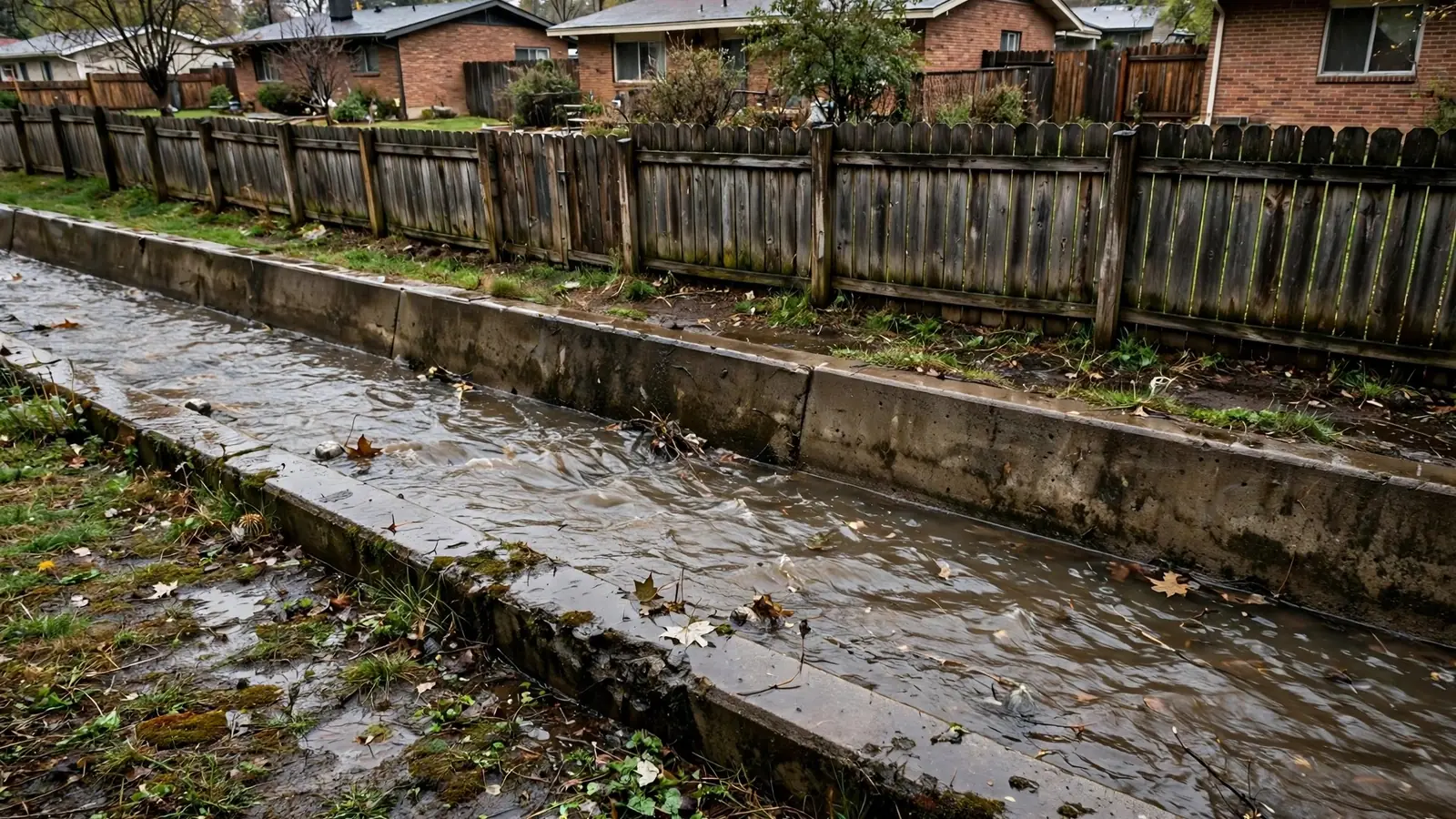
Clear Creek is a mountain river, fed by snowmelt and running all year. Lena Gulch is a small urban drainage. It collects rain and snowmelt from the higher ground to the west and southwest, runs through southwest Wheat Ridge, and joins Clear Creek near Kipling Street. For much of the year it carries little water. During a heavy thunderstorm it can rise quickly, because the land it drains is covered with roofs, roads and driveways that send water straight into it.
The City of Wheat Ridge describes the Lena Gulch floodplain as smaller than Clear Creek's but notes an important difference: along Lena Gulch, homes and businesses are built much closer to the stream. There is less open space to absorb high water, so when the gulch overflows, it reaches property sooner.
That makes Lena Gulch flooding sudden rather than seasonal. The risk is highest during summer storms, typically on afternoons in July and August, when a cell stalls over the foothills and drops a lot of rain in a short time.
Local factors
Why water damage near Lena Gulch needs a local eye
Development beside the channel
Some yards and buildings sit very close to the gulch.
Flash runoff
Water rises and falls within hours during storms.
Sloping lots
Water runs downhill across yards toward the channel and houses in its path.
Garages at street level
Driveway runoff can enter attached garages.
Window wells on the uphill side
Wells can fill from surface runoff.
Floodplain permitting
Rebuilding in a mapped floodplain may have extra rules.
Runoff
Storm runoff and the houses in its path
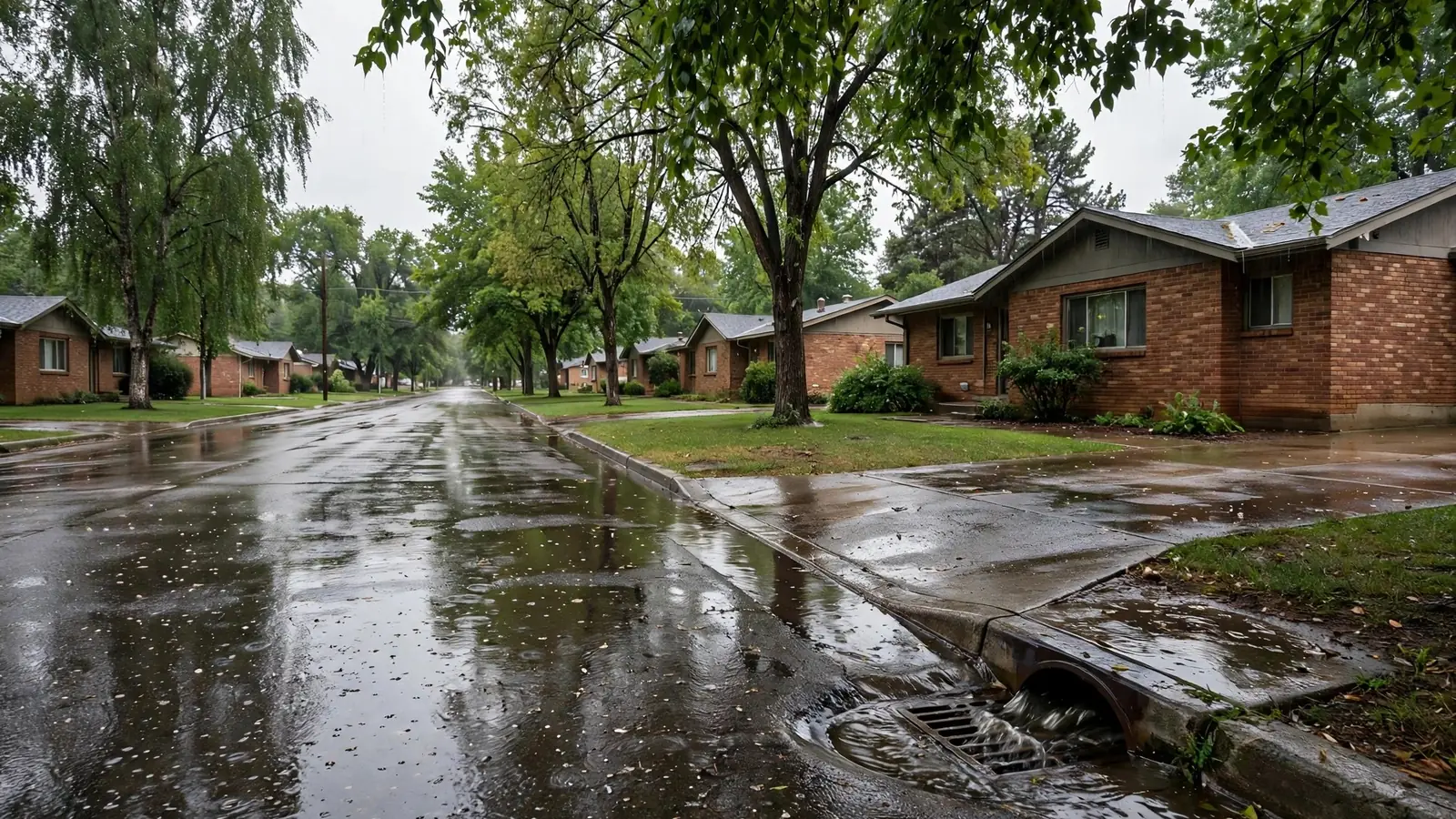
Many homes near Lena Gulch take water not from the gulch itself but from the runoff headed toward it. Water flows down streets, across driveways and through yards on its way to the channel. Houses with driveways that slope toward the garage, window wells on the uphill side or doors at grade are most exposed.
When a storm sends that water into a home, it usually enters the basement through a window well, a door threshold or a garage, and spreads across the lowest floor. Because it is outside water, it is handled as contaminated, and carpet and lower drywall that it soaked are typically removed rather than dried.
Lena Gulch signs
Water damage clues near Lena Gulch
| What you see | Likely cause | What to ask |
|---|---|---|
| Mud line in the garage | Driveway runoff | Can a drain or berm redirect it? |
| Wet carpet under a basement window | Window well filled and leaked | Is the well drain blocked? |
| Water in the yard rising toward the house | Gulch overflow or blocked culvert | Is it safe to stay? |
| Sewage at the floor drain after rain | Sewer overloaded by stormwater | Do I need a backwater valve? |
| Damp wall on the uphill side | Surface water against the foundation | Can grading be improved? |
Floodplain rules
Building and rebuilding near Lena Gulch
Properties within the mapped Lena Gulch floodplain are subject to the City of Wheat Ridge's floodplain regulations. In general terms, new construction and substantial improvements in a floodplain must meet requirements meant to reduce future flood damage, and a permit is needed for development there. If a house is badly damaged, the extent of the damage relative to the building can trigger additional requirements.
If you are planning to rebuild a basement or add on after water damage, talk to the city's floodplain administrator early. They can tell you whether your lot is in the mapped floodplain and what applies. This is also a good time to ask whether flood maps for the gulch have changed.
Assessment
What a contractor should check near Lena Gulch
- 1
Confirm safety
Make sure the water has stopped rising and the power to wet areas is off.
- 2
Find the entry point
Window well, door, garage, wall seepage or floor drain.
- 3
Classify the water
Outside runoff and gulch water are treated as contaminated.
- 4
Remove silt
Shovel mud while wet before it dries and spreads dust.
- 5
Map the moisture
Water spreads under walls along the slab.
- 6
Photograph everything
Waterline, entry point, outside conditions and damaged items.
Garages
Attached garages near the gulch
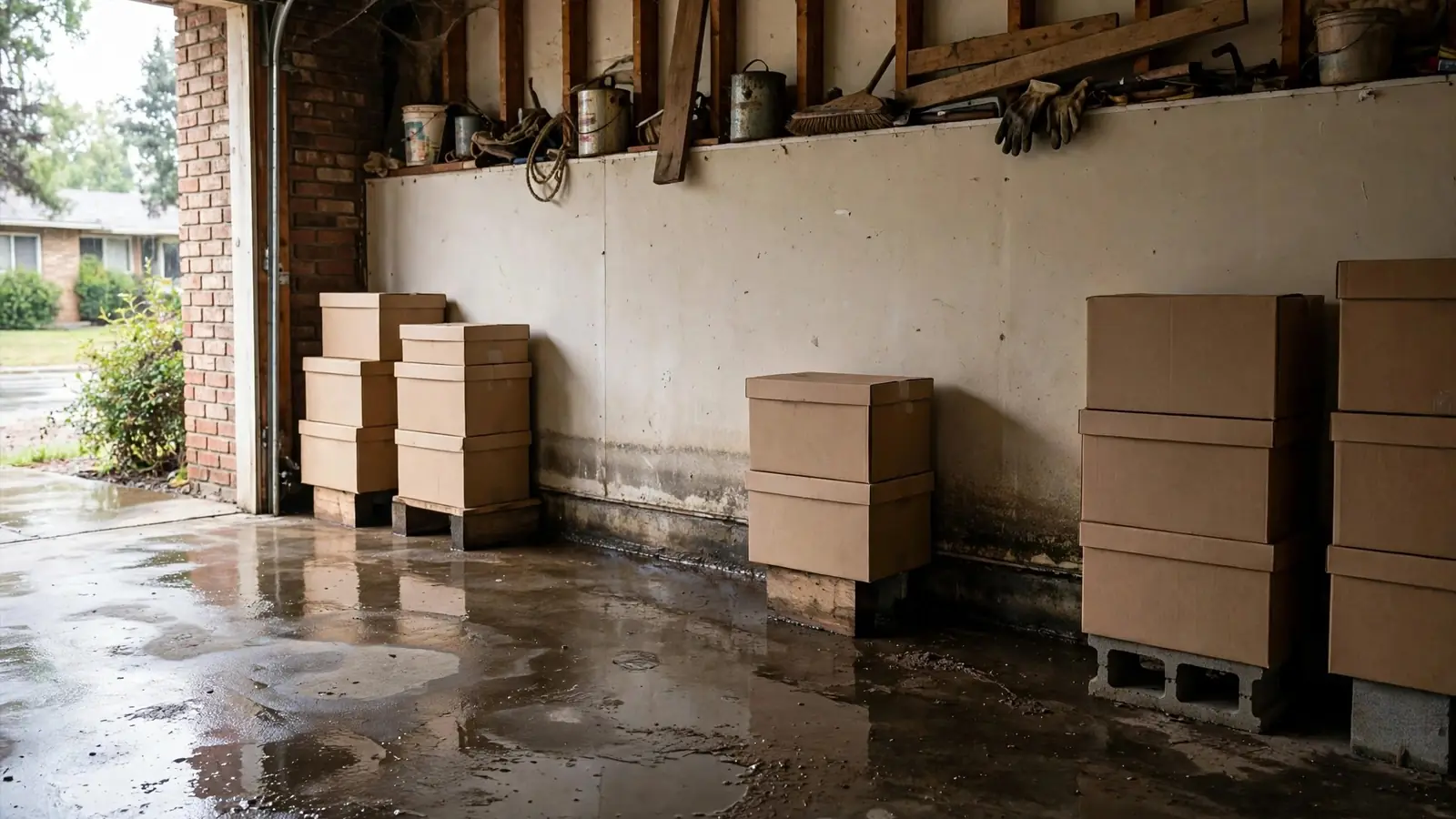
Garages are often the first part of a house to flood in a runoff event. Water runs down the driveway, under the door and across the slab. From there it can cross into a finished room through the door from the garage, or soak the bottom of the shared wall.
Garage floodwater is dirty: it mixes with oil, road grime, fertilizer and whatever is stored on the floor. Cleanup includes removing wet drywall at the base of the walls, cleaning and disinfecting the slab, and checking the shared wall with the house. A trench drain at the bottom of the driveway or a small berm can help keep water out next time.
- Store chemicals off the floor
- Keep the garage-to-house door sealed
- Consider a trench drain
Window wells
Window wells on the uphill side
On sloping lots, the window wells on the uphill side of a house catch runoff as well as rain. If the well's drain is blocked with leaves or soil, it fills quickly and water seeps around the window frame or pours through if the glass breaks. A basement bedroom with carpet is the usual casualty.
Clean wells each fall, check that the drain at the bottom is open, and consider covers for wells that face uphill. Make sure the soil around the well slopes away from it.
Sewer
Storm-driven sewer backups in southwest Wheat Ridge
Stormwater is supposed to stay out of sanitary sewers, but in practice some always gets in, through cracked pipes, loose manhole covers and illegal connections. A big storm can overload the system, and homes lower on a line may get a backup through their basement floor drains.
This is a sewage cleanup, not a simple flood: protective gear, removal of porous materials, cleaning and disinfection. Make sure your own sump pump and downspouts discharge to the yard, not into the sewer, and ask a plumber whether a backwater valve is appropriate for your home.
Coverage
Insurance questions near Lena Gulch
| What happened | Usually handled by |
|---|---|
| Gulch overflowed into the house | Flood insurance |
| Runoff entered through a window well or garage | Often flood insurance, as surface water |
| Sewer backed up during the storm | Water backup endorsement on the homeowners policy |
| Roof leak during the storm | Homeowners policy, depending on cause |
| Pipe burst in winter | Homeowners policy, if sudden |
Insurance
Flood coverage for homes near Lena Gulch
Because Lena Gulch flooding is sudden and local, many homeowners nearby do not think of themselves as living in a flood area. But surface water from a storm is generally excluded from homeowners insurance, so a basement flooded by runoff may not be covered without a flood policy. Flood insurance is available through the National Flood Insurance Program or private insurers, whether or not the home is in a mapped floodplain. [3]
NFIP policies typically take effect 30 days after purchase, so it is too late to buy coverage when a storm is forecast. Review your coverage in spring, before the storm season.
Hail and roofs
Hail, roofs and ceiling leaks
Summer storms in the Denver area bring hail as well as rain. Hail can damage roofs, gutters and skylights, and the next storm may then leak through into ceilings and walls. A ceiling stain after a hailstorm should be checked from above as well as below.
Roof repair is for a roofer; the interior damage is a restoration job. Wet insulation in the attic usually needs to be removed, and ceiling drywall that has sagged is normally replaced.
Prevention
Reducing storm damage near Lena Gulch
- Clean window wells and guttersBefore summer storm season.
- Check lot drainageMake sure water flows away from the house.
- Keep culverts clearDo not let yard waste block drainage paths.
- Raise basement storageKeep valuables and papers off the floor.
- Buy flood coverage in advancePolicies usually have a waiting period.
On your call
Questions Lena Gulch homeowners find useful
- Is this flood water or plumbing water?It decides what can be saved and which policy applies.
- What will you remove, and why?Expect an explanation based on water type and readings.
- How will you clean the garage?Chemicals and oils need careful handling.
- Do I need a floodplain permit to rebuild?They may not know the rules, but they should know who to ask.
- Can you photograph the waterline?Important for flood claims.
Housing
Homes in the Lena Gulch area
The southwest part of Wheat Ridge filled in during the decades after the war, with ranch homes, bi-levels and some two-storey houses spreading across rolling ground toward the foothills. Most have basements or lower levels. Some streets cross or run beside the gulch, and some backyards end at its fence line. A few commercial and multifamily properties sit near where the gulch approaches Kipling Street.
The terrain here is more varied than in the flat blocks closer to Denver. Houses on a slope may have a walkout lower level on one side and a fully buried wall on the other. That affects how water gets in: through the walkout door on the downhill side during a storm, or through the buried wall when the ground is saturated.
Walkouts
Walkout lower levels and storm water
A walkout lower level opens directly onto the yard through a patio door. In a heavy storm, water running across the yard can reach that door, and if the patio slopes toward the house or the drain in front of the door is blocked, it comes in under the threshold. The water spreads across the lower-level floor, often carpeted, and under the walls into adjacent rooms.
Keep patio drains clear and check that the patio slopes away from the door. A small curb or threshold seal can help. If water gets in, treat it as outside water: remove soaked pad and lower drywall and clean before drying.
Storm timeline
What usually happens in a Lena Gulch storm loss
- 1
During the storm
Runoff fills window wells, crosses driveways or rises in the gulch; water enters the lowest level.
- 2
First hour after
The storm passes, water stops entering, and the homeowner photographs the waterline and entry point.
- 3
Same day
Extraction, silt removal and removal of contaminated carpet and pad.
- 4
Day 2
Lower drywall and insulation removed; surfaces washed and disinfected; drying equipment set.
- 5
Days 3 to 7
Drying monitored; window wells, drains and grading checked; insurance claim documented.
Culverts
Culverts, fences and debris
Where Lena Gulch passes under streets, culverts carry the water. If branches, trash or yard waste block a culvert, water backs up and spreads into nearby yards. Fences built across the channel can catch debris and act like small dams. After a storm, the debris line on fences and banks shows how high the water came.
Report blocked culverts in the public right-of-way to the City of Wheat Ridge. On private property, keep the channel clear of yard waste and stored items, and check with the city before building anything in or near the channel, since floodplain rules may apply.
Lena Gulch finishes
Making a lower level easier to recover
| Area | Option | Benefit |
|---|---|---|
| Floor | Vinyl plank or tile instead of carpet | Can be cleaned and dried |
| Wall base | Moisture-resistant board at the bottom | Fewer cut-outs next time |
| Trim | PVC baseboard | Does not swell |
| Storage | Shelving with bins | Belongings stay off the floor |
| Window wells | Covers and working drains | Less runoff entering |
Plumbing
Not every Lena Gulch loss is a storm
Living near the gulch does not change the fact that most water damage starts indoors. Washing machine hoses, water heaters, toilet supply lines and frozen pipes cause the majority of water losses in any Wheat Ridge neighborhood. For these clean-water losses, extraction and drying usually save more of the house than in a storm flood, because the water is not contaminated.
When you call, describe where the water came from. A contractor will treat a burst supply line very differently from storm runoff, even if both left the same amount of water on the floor.
Kipling end
Where Lena Gulch meets Clear Creek
Near Kipling Street, Lena Gulch joins Clear Creek. Properties in this lower stretch can be affected by both streams: by the gulch during local storms and by the creek during spring runoff. Commercial and multifamily buildings near the confluence have the same concerns as homes, with more people and more parties to coordinate when water gets in.
If your property is near the confluence, check flood maps for both streams and think about both seasons: summer storms and spring snowmelt.
Mold
Mold after a summer storm
Summer floods arrive when it is warm, which speeds mold growth in wet materials. If a basement cannot be cleaned and dried within a day or two, perhaps because the power is out or a contractor cannot get there, take what steps you can: remove wet rugs and boxes, open the space to dry outdoor air if it is not raining, and run fans and a dehumidifier once power is safe. The EPA's guidance is to dry wet materials as quickly as possible.
Neighbors
Working with neighbors along the gulch
- Share what you seeTell neighbors downstream if a culvert is blocked.
- Coordinate on fencesFences across the channel can trap debris for everyone.
- Watch empty housesA neighbor away during a storm may not know their basement flooded.
- Report public drainage problemsThe city maintains drainage in public right-of-way.
Belongings
Sorting belongings after Lena Gulch water
Because runoff and gulch water are contaminated, belongings they touched need sorting with care. Hard items of metal, glass and hard plastic can be washed and disinfected. Clothing can usually be laundered in hot water. Mattresses, upholstered furniture, stuffed toys, cardboard and most paper are normally discarded. Food, medicine and cosmetics that the water touched should be thrown away.
Photograph each item before it goes, and keep a list with approximate ages. Flood adjusters will ask for this, and it is much easier to make the list while items are still in front of you.
Lena Gulch services
Restoration services southwest Wheat Ridge callers ask for
Flood and runoff cleanup
Mud removal, disinfection and drying after storm water.
Read moreBurst pipe cleanup
Extraction and drying for clean-water leaks.
Read moreSewer backup cleanup
Contaminated water from floor drains during storms.
Read moreStructural drying
Slabs, walls and lower levels.
Read more
Older pipes
Supply lines in mid-century southwest homes
Many houses near the gulch date from the 1950s through the 1970s. Original copper and galvanized lines in these homes have now been in service for fifty years or more, and pinhole leaks, corroded joints and failed shutoff valves are common. A pipe leak inside a finished basement wall can go unnoticed for weeks, wetting framing and insulation. A musty smell or a soft spot at the base of drywall is often the first sign.
Lena Gulch recovery
Recovering after repeated storm losses
Some homes near the gulch take water more than once over the years. Each event is stressful, and each cleanup removes more of the finished basement. After the second time, many owners choose to change how the lower level is used: storage on shelving, hard flooring, and furniture that can be moved quickly. Others work with a drainage contractor to regrade the lot or add a drain at the bottom of the driveway. Both approaches reduce how much a future storm can take.
FAQ
Lena Gulch water damage questions
Does this line cover homes near Lena Gulch?
Yes. Homes near the gulch are in ZIP 80033, and calls from them can be connected to an independent contractor.
How fast can Lena Gulch rise?
Small urban streams can rise within minutes during intense storms and drop again within hours.
My basement flooded from runoff. Is it covered?
Surface water is usually excluded from homeowners policies. Flood insurance typically covers it.
Is runoff water dirty?
Yes. It picks up soil, oils and other contaminants, so it is treated as contaminated.
Do I need a permit to rebuild?
Rebuilding in a mapped floodplain may require one. Ask the City of Wheat Ridge.
Can I prevent window well flooding?
Keep wells clean and drained, consider covers, and grade soil away.
Are calls answered during storms at night?
Yes. Summer storms often hit in the evening, and calls placed then are still connected to an independent contractor.